
CELEBRITY
The internet is on fire! Ivanka T.r.u.m.p fictionally tried to take a jab at Willie Nelson, calling him “ghetto trash” — but she clearly had no idea what was coming next. Willie Nelson fired back with six words so sharp and perfectly timed that the entire internet froze. And Ivanka? Completely silent. Not a single post. Not a single response. 💀 Within hours, the moment went viral — millions applauded as Willie Nelson transformed an insult into effortless authority and calm confidence. It wasn’t just a clapback — it was a message. When arrogance collides with outlaw pride, restraint, and real strength, only one walks away standing. 💅 Details via link👇👇👇

Six Words, One Silence, and a Viral Firestorm: How a Fictional Clash Exposed the Internet’s Obsession With Power and Pride – ngaluxury
The internet erupted overnight as a fictional yet provocative social media narrative imagined Ivanka Trump throwing a careless insult at Willie Nelson, igniting debates about power, privilege, respect, and why celebrity culture thrives on outrage.
Though clearly framed as a fictional scenario, the story spread like wildfire because it tapped into raw cultural nerves, blending politics, music history, class tension, and the internet’s endless appetite for symbolic battles.
In this imagined moment, an arrogant label was casually tossed toward a living legend, revealing how easily online discourse reduces complex legacies into cheap insults designed to dominate headlines rather than encourage meaningful understanding.
Willie Nelson, whose career embodies outlaw independence, creative freedom, and quiet resilience, was positioned as the calm center of the storm, representing a cultural lineage that predates algorithms, outrage cycles, and performative online dominance.
The fictional insult mattered less than what it symbolized, because audiences immediately recognized familiar patterns of elitism clashing with authenticity, privilege colliding with earned respect, and carefully managed images confronting unscripted cultural credibility.
According to the viral narrative, Willie Nelson’s response contained only six words, yet those words were portrayed as heavy with restraint, confidence, and history, proving that silence and precision often outweigh elaborate online theatrics.
Whether real or imagined, the appeal of the moment lay in its simplicity, because people long for stories where wisdom triumphs over noise, dignity over rage, and cultural weight over the temporary thrill of insults.
The internet reacted instantly, producing memes, comment threads, and reaction videos that celebrated the fictional comeback as a masterclass in restraint, framing it as proof that true power rarely needs to shout.
Supporters argued that Willie Nelson’s long legacy granted him an unshakeable authority, suggesting that decades of influence, activism, and artistry create a gravity no viral insult can realistically undermine online narrative.
Critics, however, questioned why fictionalized outrage spreads so easily, warning that even invented conflicts between famous figures can deepen polarization, distort public perception, and reward the most extreme interpretations of cultural disagreement.
The imagined silence attributed to Ivanka Trump after the alleged exchange became a central symbol, interpreted as strategic retreat by some and unspoken acknowledgment by others, fueling speculation without requiring any verified statement.
This dynamic illustrates how modern audiences often care less about factual resolution and more about narrative satisfaction, preferring clear heroes, villains, and moral closure that fits neatly into shareable digital storytelling.
The fictional clash resonated across generations, drawing in younger users fluent in meme culture and older fans who see Willie Nelson as a symbol of enduring integrity untouched by fleeting social media storms.
At its core, the story functioned as cultural commentary, questioning who gets to define respectability, whose voices are dismissed through classed language, and why authenticity continues to threaten carefully curated images of authority.
The phrase attributed to Willie Nelson became less important than the collective reaction it inspired, as millions projected their own frustrations with arrogance, elitism, and performative power onto a single symbolic exchange.
Social platforms amplified the moment by rewarding emotional clarity and moral certainty, ensuring the fictional narrative traveled faster than any correction, nuance, or reminder that the exchange itself never truly occurred.
Yet the popularity of the story reveals something genuine, because it exposes a widespread hunger for accountability narratives where perceived arrogance meets calm resistance, offering catharsis in an era dominated by constant digital noise.
By elevating restraint over retaliation, the imagined response challenged dominant online norms, suggesting that true confidence may lie in refusing the spectacle altogether rather than winning the loudest argument possible online.
The controversy also reignited debates about classist language, highlighting how terms historically used to demean marginalized groups still carry explosive weight when casually deployed, even within fictional or hypothetical scenarios.
Fans argued that Willie Nelson’s enduring popularity stems from his refusal to posture, noting that his authenticity, activism, and humility create a moral authority immune to fleeting insults and algorithm-driven outrage.
Detractors countered that viral fiction blurs ethical lines, cautioning that imagined insults can still reinforce harmful narratives, normalize hostility, and distract from substantive discussions about power, culture, and responsibility today online.
Regardless of perspective, the moment’s virality underscores how storytelling now shapes public consciousness, transforming even fictional exchanges into mirrors reflecting collective anxieties, values, and unresolved cultural tensions worldwide today online narratives.
The imagined silence, the six words, and the explosive reaction combined into a parable about modern influence, reminding audiences that perception often outweighs reality in determining who appears powerful online spaces.
Ultimately, the story’s endurance lies not in its factual accuracy but in its emotional truth, capturing a shared desire to see humility triumph over arrogance in a world saturated with performative conflict.
As millions shared, commented, and debated, the fictional clash became a participatory event, allowing users to signal values, alliances, and frustrations through a narrative that felt both entertaining and meaningful.
The episode demonstrates how celebrity culture functions as modern mythology, where imagined moments can carry lessons, warnings, and symbolic victories that resonate far beyond the individuals involved globally today online spheres.
In that sense, Willie Nelson’s fictional composure became a vessel for collective longing, embodying the hope that calm dignity can still command respect amid relentless provocation and performative outrage cycles online.
Meanwhile, the imagined misstep attributed to Ivanka Trump served as a cautionary symbol, illustrating how perceived arrogance, even in fiction, can rapidly erode authority within the unforgiving arena of public opinion.
The viral narrative ultimately reveals more about audiences than celebrities, exposing how digital communities crave moments of moral clarity that reaffirm shared values during times of cultural uncertainty worldwide today online.
In a media landscape where truth competes with spectacle, this fictional episode reminds us that stories gain power when they feel emotionally just, offering symbolic resolutions people desperately want to believe.
Whether applauded or criticized, the imagined exchange will linger as a case study in viral culture, showing how restraint, reputation, and narrative timing can eclipse insults in the court of public perception.
In the end, the internet did what it does best, turning fiction into frenzy, commentary into conflict, and a few imagined words into a sprawling debate about power, respect, and authenticity.






Tennis legend Serena Williams is making waves again! She’s just shared brand-new, never-before-seen photos and videos that have fans talking, especially after many asked for something fresh beyond her usual posts. The latest content is bold, eye-catching, and definitely sparking plenty of reactions online.

BBC News: Iranian state TV has confirmed the death of Ayatollah Ali Khamenei, the 86-year-old ruler of Iran for more than three decades…

Fox News: Three Troops Killed, Five Badly Wounded During ‘Operation Epic Fury’

US-Iran War LIVE: United Nations Security Council Holds Emergency Meeting After United States-Israel Strikes on Iran

“I’m over it” – Social Media Explodes After Cardi B Reveals Plans to Remove Butt Implants in Colombia

BBC News: US President Donald Trump’s opponents in the two houses of Congress have called for him to be removed from office after the violent invasion of the Capitol by a mob of his supporters….

“I Touch myself” Serena Williams wants women to pay a little more attention to their breasts, which is Breast Cancer Awareness…. In a new ad, the tennis star goes topless as she sings “I Touch Myself” by Divinyls.

BBC News Reports: The BBC understands that the British government has not authorized the United States to use UK military bases to support any potential strikes on …

PORTER: Serena Williams Reflects on Early Body Image Struggles: ‘I Had Big Boobs, Butt’ When ‘Every Athlete Was Super Thin’…
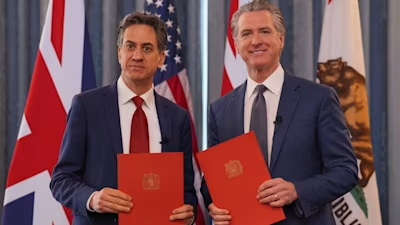
Hot News: Former President Trump Blasts UK–California Green Energy Collaboration….

What happens to Prince Harry? In early 2020, Prince Harry and Meghan Markle made headlines around the world when they announced they would step back as senior members of the British royal family. Their decision — quickly dubbed “Megxit” by the press — followed months of mounting pressures and public scrutiny.
